
Latest Blogs
How Long Does It Take to Become Fluent in German?
How Long Does It Take to Become Fluent in German?
“How long will it take me to learn German?”
If you’re thinking about learning German, this is probably one of the first questions that comes to mind.
The honest answer is: it depends.
Learning basic German for travel is very different from reaching the level required to study at a German university or communicate confidently in a professional workplace. Your timeline will depend on your target level, how regularly you study, how much speaking practice you get and whether you follow a structured learning plan.
The good news is that German fluency is absolutely achievable when you approach it with realistic goals and consistent practice.
Let’s understand what the journey can look like.
What Does “Fluent” German Actually Mean?
Fluency isn’t one specific point where you suddenly become fluent.
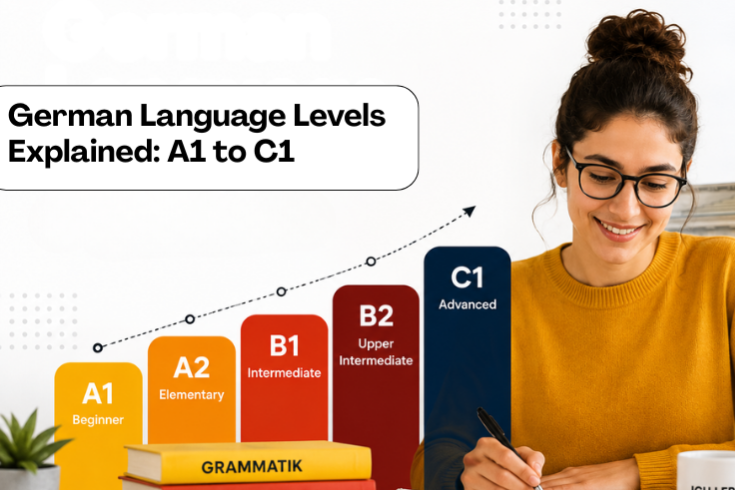
German proficiency is commonly measured using the Common European Framework of Reference for Languages (CEFR), which ranges from A1 to C2.
The levels are broadly:
- A1: Beginner
- A2: Elementary
- B1: Intermediate
- B2: Upper-intermediate
- C1: Advanced
- C2: Near-native mastery
For many learners, B2 is the practical meaning of fluency. At this stage, German becomes a usable language for work, study and everyday communication rather than something that requires constant translation in your head.
However, your personal definition of fluency may be different.
If your goal is simply to travel around Germany and handle everyday situations, you may not need B2. If you want to work or study in German, you may need B2 or even C1 depending on your situation.
How Many Hours Does It Take to Learn German?
There is no fixed number of hours that guarantees fluency.
However, the document provides useful estimated study ranges for different CEFR levels.
A1 – Beginner
Approximately 60–80 hours
At A1, you can:
- Introduce yourself
- Ask basic questions
- Understand simple expressions
- Handle basic everyday interactions
This is the stage where you’re building your foundation.
A2 – Elementary
Approximately 150–200 cumulative hours
At A2, you can communicate in familiar and routine situations and understand frequently used expressions.
This can be enough for basic travel and simple everyday communication.
B1 – Intermediate
Approximately 350–400 cumulative hours
B1 is where your German starts becoming much more functional.
You can understand the main points of clear speech, communicate about familiar subjects and manage many travel and everyday situations.
For many learners, this is the stage they describe as becoming conversational in German.
B2 – Upper-Intermediate
Approximately 540–750 cumulative hours
At B2, you can discuss more complex subjects, understand native speakers at normal speed and use German in professional environments.
For learners whose goal is workplace communication or practical fluency, B2 is an important milestone.
C1 – Advanced
Approximately 750–900+ cumulative hours
C1 allows you to understand complex academic material, express yourself spontaneously and use German flexibly in professional situations.
How Long Will It Take Based on Your Study Schedule?
The number of hours you study each week makes a major difference.
For example, according to the document:
Around 1 hour per day:
You could potentially reach A1 in 2–3 months, B1 in approximately 10–14 months and B2 in around 20–30 months.
Around 5 hours per week through structured classes:
A1 may take around 3–4 months, B1 around 14–18 months and B2 approximately 2.5–3 years.
Around 10–15 hours per week through intensive study:
A1 may take around 1–2 months, B1 around 6–9 months and B2 around 12–18 months.
These are estimates rather than guarantees. Your previous language-learning experience, study methods, speaking practice and consistency can all affect your progress.
How Long Does It Take to Become Conversational in German?
For most learners, B1 is a useful benchmark for conversational German.
At this level, you can discuss familiar subjects, understand the main points of clear conversations and manage common situations while travelling.
With consistent part-time study, the document estimates approximately 10–14 months to reach B1 for many learners.
However, you don’t have to wait a year before speaking German.
You should begin speaking from the beginning, even if your sentences are very simple.
Learning phrases such as:
- Ich heiße… – My name is…
- Ich komme aus… – I come from…
- Wie geht es Ihnen? – How are you?
- Ich möchte… – I would like…
- Wo ist…? – Where is…?
allows you to start using the language while you’re still building your grammar and vocabulary.
How Long Does It Take to Become Fluent in German?
If by “fluent” you mean practical professional fluency around B2, the document estimates approximately 20–30 months for a learner studying around one hour a day at a steady pace.
With intensive study of 10–15 hours per week, the same milestone may potentially be reached in approximately 12–18 months.
This is why consistency is so important.
Studying for 30 minutes every day can be more sustainable and useful for long-term retention than studying for several hours once a week and then taking long breaks.
What Level of German Do You Actually Need?
You don’t always need “fluency.”
Your ideal target should depend on why you’re learning German.
For Travel and Everyday Conversation
A2 to B1 can often provide a useful foundation for travel, casual conversations and routine interactions.
For Working in Germany
B2 is a common practical target for workplace communication. It can help you participate in meetings, write emails and handle professional conversations with greater independence.
For University
Depending on the university and program, learners may need B2 or C1 German, with proficiency demonstrated through recognised examinations such as TestDaF, DSH or telc C1 Hochschule.
Always check the specific language requirements of your chosen university and course.
For Advanced Academic or Professional Work
C1 may be appropriate for careers or academic programs where advanced German communication is essential.
The important lesson is simple: don’t spend years chasing C1 if your actual goal only requires B1 or B2.
Set your target according to your purpose.
Is German Difficult to Learn?
German has some features that can initially feel challenging.
Learners often find the following difficult:
- Four grammatical cases
- Three grammatical genders
- Word order
- Compound words
- Grammar rules that differ from English
But German also has an advantage for English speakers.
The two languages share significant vocabulary because of their Germanic linguistic roots. This means some German words and structures may feel familiar to English-speaking learners.
Overall, the document describes German as more challenging than languages such as Spanish or French, while still being considerably more approachable than languages such as Mandarin or Arabic for English speakers.
How Can You Learn German Faster?
You don’t necessarily need to study for hours every day.
Instead, focus on making your learning routine effective.
1. Practise Every Day
Consistency is more important than occasional bursts of intensive study.
Even 30 minutes of daily German practice can help you maintain momentum and reinforce what you’ve already learned.
2. Combine Classes with Speaking Practice
Learning grammar and vocabulary is important, but passive knowledge doesn’t automatically become conversational ability.
You need to use German.
Practise conversations with a teacher, tutor or fluent speaker. Speaking regularly helps transform what you know into what you can actually say.
3. Set a Specific CEFR Goal
Instead of saying:
“I want to become fluent in German.”
Set a measurable goal:
“I want to reach A2 for travel.”
or:
“I want to reach B2 for professional communication.”
A specific target makes your progress easier to measure and keeps your learning journey focused.
4. Add German to Your Everyday Life
Try incorporating German into activities you already enjoy.
You can:
- Listen to German podcasts.
- Watch German videos.
- Follow German-speaking creators.
- Read simple German articles.
- Listen to German music.
- Practise conversations.
- Change selected apps or devices to German.
Regular exposure can help you become more comfortable with natural pronunciation and everyday vocabulary.
Can You Become Fluent in German in Three Months?
For most complete beginners, reaching genuine B2-level fluency in three months is not a realistic expectation.
The document indicates that three months of consistent daily study can potentially take a beginner through A1 and into early A2, but genuine B2 proficiency requires substantially more study time.
Rather than trying to become fluent as quickly as possible, focus on making steady progress.
Three months of consistent learning is still a significant achievement if you move from knowing almost no German to being able to introduce yourself, understand simple phrases and handle basic interactions.
Learn German with Divine Daivik Diksha
A structured learning path can make a significant difference when you’re trying to build German proficiency.
Divine Daivik Diksha offers structured, CEFR-aligned German language classes in Kharadi, Pune, designed to guide learners progressively from A1 towards conversational and professional proficiency levels.
Instead of treating “fluency” as one distant goal, learners can work towards clear milestones and develop their German skills progressively.
Whether you’re a beginner learning German for the first time, preparing for future education opportunities, planning to work in a German-speaking environment or simply interested in learning the language, a structured course can help you build the right foundation.
So, How Long Will It Take You?
There is no universal answer.
Your timeline depends on:
Your goal – A2, B1, B2 or C1?
Your schedule – How many hours can you realistically study every week?
Your consistency – Can you maintain your routine for months?
Your learning method – Are you combining structured lessons with speaking, listening and revision?
Your exposure – How often do you actually use German outside your classes?
For a consistent part-time learner, reaching B1 conversational ability may take around 10–14 months, while reaching practical B2 fluency may take roughly two to three years. More intensive study can shorten these timelines.
The most important thing is not how quickly someone else learned German.
It’s how consistently you can keep learning.
Start Learning German with a Clear Goal
German fluency is a realistic goal when you break the journey into achievable stages.
Start with A1. Build your vocabulary and grammar. Practise speaking. Move towards B1. Then work towards B2 if your career, education or personal goals require it.
With the right structure and consistent practice, every level brings you closer to using German confidently in real life.
If you’re ready to begin, explore German language classes at Divine Daivik Diksha and start your German learning journey with a structured approach that matches your goals and pace.
Recent Blogs

Life Lessons from Bhagavad Gita for Students
Read Full Blog
Carnatic Vocal Training Guide for Beginners
Read Full Blog
Benefits of Learning Multiple Languages for Students
Read Full Blog
How Public Speaking Classes Improve Confidence
Read Full Blog
Carnatic Flute Classes Online – Flute vs Violin for Beginners
Read Full Blog
Learn Bhagavad Gita Online – Life Lessons for Kids & Adults
Read Full Blog
Online Shloka Classes – Spiritual Growth for Kids & Adults
Read Full Blog
Online Carnatic Vocal Classes – Learn Classical Singing from Home
Read Full Blog
How-to-Learn-Shlokas?
Read Full Blog
Why Learning Violin Is a Great Choice?
Read Full Blog
How long does it take to learn Carnatic music?
Read Full Blog
How to Practice Bharatanatyam
Read Full Blog
Benefits of Joining Online Carnatic Vocal Classes for Kids and Adults
Read Full Blog
How to Choose the Best Online Carnatic Vocal Classes?
Read Full Blog
Top 6 Instruments to Learn in Carnatic Music
Read Full Blog