
Duolingo vs Online Language Classes: Which Works?
Learning a foreign language has never been more accessible. Today, a student can download a language-learning app, spend 10–15 minutes a day practising vocabulary and start building basic sentences almost immediately. But there is an important question: Can an app such as Duolingo actually make you fluent, or are live online language classes a better choice?
The answer depends on what you mean by “fluent” and how you learn best. Apps and live classes serve different purposes. Duolingo can be an excellent tool for building a daily learning habit, vocabulary and basic language knowledge. However, learners who want confident real-world communication may benefit from structured lessons, speaking practice, teacher feedback and regular interaction.
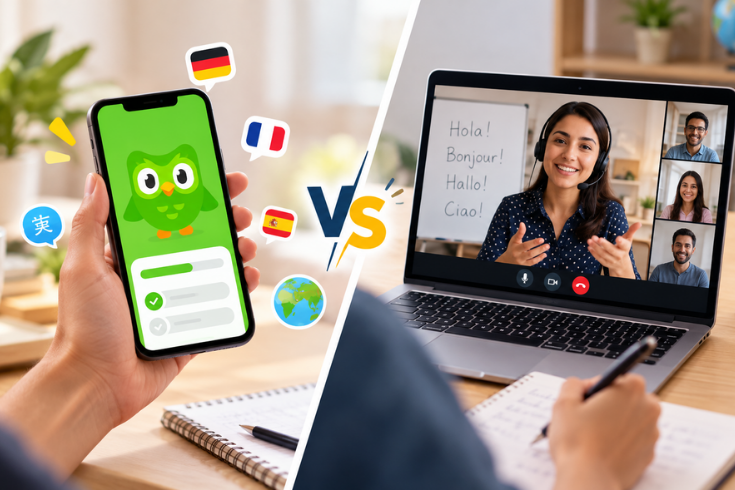
Duolingo vs Online Classes: What Is the Difference?
The biggest difference is the learning environment.
A language-learning app is primarily self-study . You decide when to study, how long to practise and how quickly to move through the lessons. This makes apps convenient for busy students, professionals and beginners who want to explore a language before committing to a course.
Live online language classes, on the other hand, provide a teacher-led learning environment. Students attend scheduled sessions, ask questions, practise conversations and receive guidance based on their individual progress.
Neither approach is automatically better. The right option depends on your goals.
What Is Duolingo Good At?
Duolingo has become popular because it makes language practice simple and engaging. Short lessons, repetition, exercises and gamification can make it easier to develop a consistent study habit.
Research on Duolingo has found positive outcomes, particularly in reading and listening. One study of beginning Spanish and French learners found that students completing beginner-level Duolingo courses reached measurable proficiency in reading and listening.
Duolingo has also studied its learners' speaking performance. Its research found that approximately half of tested Spanish and French learners who reached the end of the beginner material achieved A2-level speaking skills or higher.
This shows that Duolingo effectiveness should not be dismissed. It can genuinely help learners develop language skills.
But there is an important distinction between learning language content and being comfortable using that language spontaneously with another person.
Where Language Apps Have an Advantage
Language apps are particularly useful for:
- Building vocabulary
- Revising previously learned words
- Practising basic grammar
- Developing a daily learning habit
- Reviewing phrases and sentence structures
- Learning at your own pace
- Getting additional practice outside class
For example, a student attending a Spanish class can use an app for 10 minutes each day to revise vocabulary covered during the lesson.
This combination can be much more effective than treating an app as the only source of learning.
Can Duolingo Make You Fluent?
This is where expectations matter.
If by fluency you mean being able to recognize common vocabulary, understand basic sentences and construct simple conversations, an app can take you a significant distance.
But advanced fluency involves much more. You need to understand different accents, respond without translating every sentence mentally, express opinions, handle unexpected questions and communicate naturally in real situations.
A 2025 critical review of research on Duolingo's role in developing adult speaking skills found evidence of modest improvements in pronunciation and sentence-level fluency, while also pointing to limitations in developing broader oral communication.
In other words, Duolingo can be part of your fluency journey, but it should not necessarily be your entire journey.
Why Speaking Practice Matters
Imagine that you have memorized hundreds of Spanish words.
You know how to say comer , trabajar , familia and viaje . You understand basic sentence structures and can complete an exercise correctly.
Then someone suddenly asks you a question in Spanish.
Can you respond naturally?
This is where many self-study learners discover a gap.
Real communication requires active recall. You need to listen, understand, formulate a response and speak—all within a conversation.
Live online classes can create opportunities for this kind of speaking practice . At Divine Daivik Diksha, foreign-language programs emphasize speaking along with listening, reading and writing. The academy offers live online courses in French, Spanish, German and Japanese, with interactive sessions and personalized learning.
Live Online Classes: The Advantage of a Teacher
One of the biggest advantages of learning with a teacher is immediate feedback.
Suppose you pronounce a word incorrectly. An app may tell you that the answer is incorrect, but a teacher can explain why the pronunciation sounds wrong and show you how to correct it.
Similarly, if you repeatedly make a grammatical mistake, a teacher can identify the pattern and explain it using examples that make sense to you.
This becomes particularly valuable as the language becomes more advanced.
At Divine Daivik Diksha, live classes are designed around interactive learning, speaking practice and personalized guidance. For example, its French program includes structured CEFR learning from A1 to C1, speaking, listening, reading, writing and certification preparation.
Self-Study vs Tutor: Which Is Better?
| Factor | Language App | Live Online Class |
|---|---|---|
| Flexibility | Excellent | Good |
| Vocabulary practice | Excellent | Excellent |
| Daily revision | Excellent | Good |
| Grammar explanation | Basic to moderate | Personalized |
| Speaking practice | Limited/structured | Interactive |
| Pronunciation feedback | Automated | Teacher-guided |
| Conversation | Limited | Strong |
| Personal feedback | Limited | Strong |
| Accountability | Self-driven | Teacher-supported |
| Exam preparation | Limited | Structured |
The difference is particularly important for students who are learning a language for school, higher education, international certification or career opportunities .
The Best Approach May Be Both
Instead of thinking of the choice as Duolingo vs online classes , consider using both for different purposes.
Use your language app for short daily practice.
Use live classes to learn grammar systematically, practise conversations, ask questions and receive feedback.
For example:
- 15 minutes: Vocabulary and revision on an app
- 2–3 times a week: Live language class
- Daily: Listen to songs, conversations, podcasts or videos
- Weekly: Speak using the vocabulary and grammar you have learned
This creates a learning cycle where the app reinforces what the teacher teaches, while the teacher helps turn passive knowledge into active communication.
Which Is Better for Children and Students?
For younger learners, apps can make language learning enjoyable and encourage regular exposure. However, children may still need guidance to understand grammar, pronunciation and sentence formation correctly.
A teacher can also adjust the pace according to the child's level rather than expecting the learner to navigate everything independently.
For students preparing for examinations or international certifications, structured classes can be particularly useful because they provide a planned syllabus, assignments, mock tests and targeted preparation.
Divine Daivik Diksha offers personalized online language learning for children and adults, including foreign languages such as French, Spanish, German and Japanese. Its courses cover different combinations of speaking, listening, reading, writing, grammar and certification preparation depending on the language and learner's goals.
So, Duolingo or Online Classes?
The answer depends on your objective.
Choose a language app if you want to:
- Try a language before enrolling in a course
- Build a daily learning habit
- Revise vocabulary
- Practise independently
- Supplement your existing classes
Choose live online classes if you want to:
- Develop conversational confidence
- Understand grammar properly
- Receive pronunciation corrections
- Get personalized feedback
- Prepare systematically for certification
- Follow a structured learning path
And if your goal is genuine communication, combining the two can be even better.
Final Thoughts
The real question isn't simply “Duolingo vs online classes—which one wins?” It is “What kind of learner am I, and what level of language ability do I want to achieve?”
Language apps are excellent for convenience, repetition and consistency. They can help learners develop meaningful skills and provide a low-pressure way to start learning.
But fluency is more than completing lessons and collecting vocabulary. It involves listening, thinking, responding and communicating with confidence.
For learners who want structured guidance and real speaking practice, live online language classes can provide the human interaction that self-study often lacks. The smartest approach may be to use technology for daily practice while learning the deeper aspects of communication with an experienced teacher.
Start with an app if you want to explore. Choose structured classes when you're ready to communicate. And use both when you want to make consistent progress.